Struggling to Meet People? What to Do If You Have No Friends
Feeling like you have no friends is more common than you think, and it's not a reflection of your worth. Whether you're socially anxious, newly isolated, or simply starting over, this honest, research-backed guide walks you through exactly what to do when you're struggling to meet people and build real connections.
Editorial Team
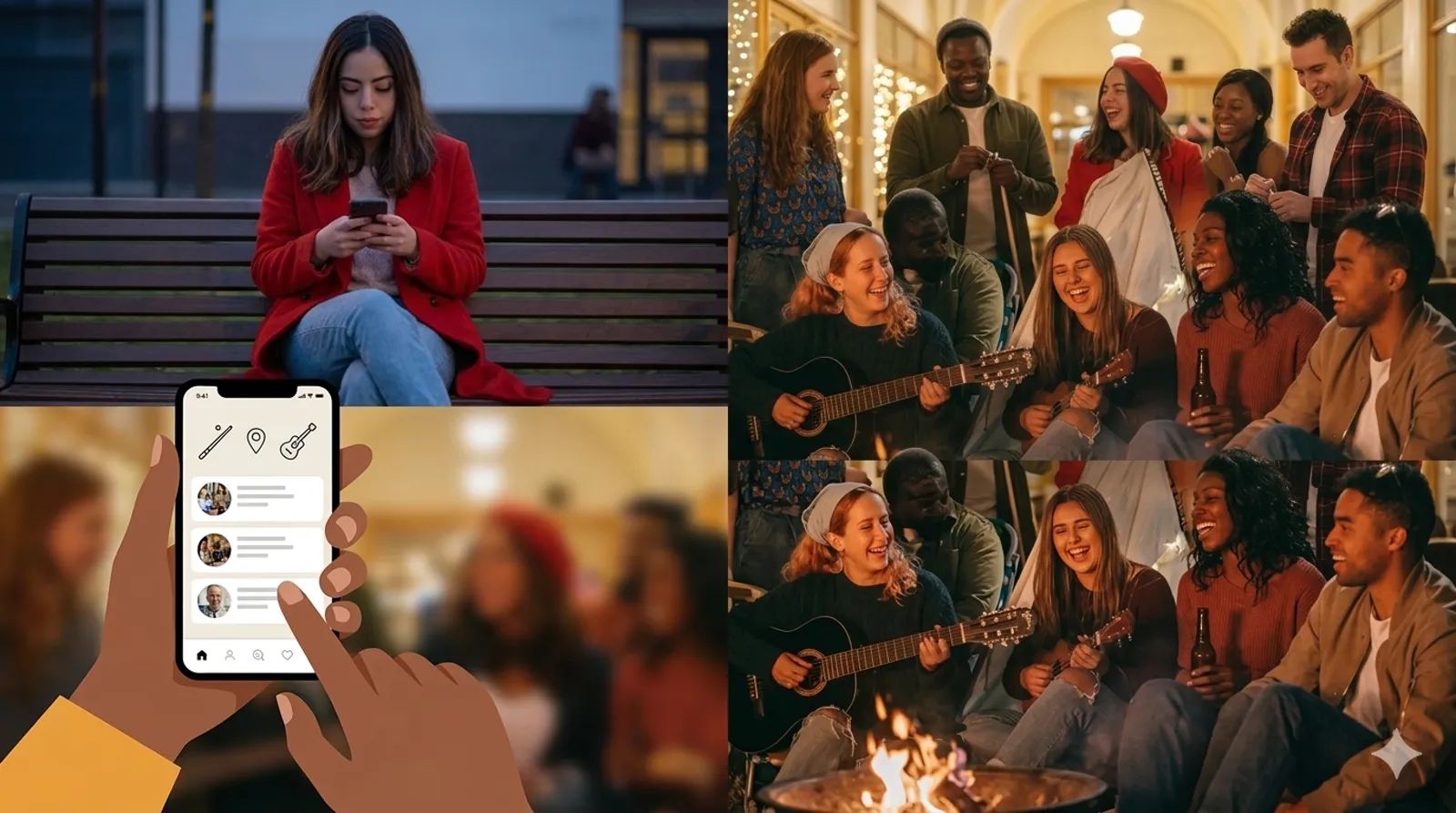
First: You're Not Broken, and You're Not Alone
If you've typed 'I have no friends' into a search bar at any point in your life, you're in much larger company than you might imagine. A 2021 survey by the Survey Center on American Life found that 12% of Americans report having no close friends at all, a figure that has quadrupled since 1990. And that's just the people willing to admit it. The actual number is almost certainly higher.
Loneliness has a way of convincing you that your situation is uniquely shameful, that everyone else has rich, easy, effortless social lives while you're the odd one out. This is a lie the isolated brain tells itself, and it's one worth dismantling immediately. Former U.S. Surgeon General Dr. Vivek Murthy declared loneliness a public health epidemic in 2023, noting it affects people across every age group, income level, and social background. You are not uniquely flawed. You are experiencing one of the defining struggles of modern life, and there are concrete, evidence-based steps out of it.

Why Having No Friends Happens to Good People
Before jumping to solutions, it's worth understanding the roots, because 'I have no friends' rarely means 'I am unlikeable.' It almost always means one or more of the following structural or psychological forces have been at play:
- Life transitions disrupted your existing social infrastructure. Moving to a new city, graduating from university, changing careers, going through a divorce, becoming a parent, or losing a loved one can all dismantle the social environments that friendships naturally grow in. Research shows that most adult friendships are proximity and repetition-dependent, when those structures disappear, friendships often quietly dissolve with them.
- Social anxiety has been holding you back. Social Anxiety Disorder affects approximately 15 million American adults and is one of the leading causes of chronic friendlessness. It's not shyness, it's a clinical condition that makes social situations feel genuinely threatening, causing avoidance that compounds over time.
- Depression has narrowed your world. One of depression's most cruel mechanisms is that it withdraws motivation for the very activities, socializing, reaching out, leaving the house, that would most help alleviate it. If lethargy and withdrawal are part of your picture, depression may be worth addressing alongside the social piece.
- Modern life has been quietly isolating you. Remote work, streaming entertainment, food delivery, and social media have made it entirely possible to go days or weeks without meaningful human interaction. Convenience has accidentally engineered solitude into the fabric of daily life for millions of people.
- You've simply aged out of the structures that made friendship easy. School, university, and early workplaces provide built-in, repeated, low-stakes exposure to peers, the exact conditions that social scientists identify as ideal for friendship formation. Most adults lose all three simultaneously and are never taught how to replace them.
Understanding which of these applies to you is the first practical step. Because the solution to 'I moved to a new city and lost my social network' looks different from 'I've had social anxiety my whole life and have always struggled to connect.'

The Honest Truth About What It Takes to Change This
Here is something most advice articles won't tell you directly: building a social life from scratch as an adult is genuinely hard, genuinely slow, and will require you to be uncomfortable, sometimes repeatedly. Research from the University of Kansas found it takes an average of 50 hours of shared time to move from stranger to casual friend, and over 200 hours to build a close friendship. That doesn't happen in a weekend. It happens across months of consistent, intentional showing up.
This isn't discouraging, it's liberating. It means your current situation isn't a verdict on who you are. It just means the work hasn't been done yet. And work, unlike charm or luck, is entirely within your control. Here's where to start.
Step 1: Address the Inner Barriers First
If social anxiety, depression, extreme shyness, or deep loneliness-driven fear is the primary obstacle, no amount of Meetup groups or friendship apps will help until that layer is addressed. These aren't character flaws, they're treatable conditions that respond well to professional support.
Cognitive Behavioral Therapy (CBT) is the gold-standard treatment for social anxiety, with decades of evidence showing it rewires the thought patterns that make socializing feel threatening. BetterHelp and Talkspace offer accessible online therapy options if in-person feels too daunting. Group therapy, paradoxically, is often particularly effective for social anxiety, it treats the condition in the very environment that triggers it, with professional guidance and peer support simultaneously.
If your barrier is more existential, a general sense of not knowing who you are or what you have to offer socially, practices like journaling, values clarification, or even a personal development course can help rebuild the self-concept that makes approaching others feel possible rather than presumptuous.
Step 2: Start Smaller Than You Think You Should
One of the most common mistakes people make when trying to overcome friendlessness is aiming too high too fast, signing up for a 20-person social event when even one-on-one conversation feels overwhelming, or trying to build five friendships simultaneously when one would stretch their bandwidth. This leads to overwhelm, self-comparison, and retreat.
Instead, start embarrassingly small. Say good morning to your neighbor. Exchange names with the person at your regular coffee shop. Reply to someone's Instagram story with a genuine comment. These micro-interactions are not trivial, they are the atoms from which social confidence is built. Research by Epley and Schroeder consistently shows that people dramatically underestimate how positively strangers respond to small, warm interactions, and that these brief exchanges meaningfully improve mood and sense of connection for both parties.
Build from there. One small win creates the confidence for the next slightly larger one. Social skills, like physical fitness, respond to progressive overload, not to throwing yourself into the deep end all at once.

Step 3: Find Your Recurring Third Place
Sociologist Ray Oldenburg coined the term 'third place' to describe the social environments beyond home (first place) and work (second place) where community naturally forms, barbershops, coffee shops, community centers, libraries, places of worship, gyms. Research shows that having a consistent third place is one of the strongest predictors of social integration and a sense of belonging.
The key word is recurring. One-off events almost never produce lasting friendships. It's the weekly pottery class, the Thursday evening running club, the monthly book group where real bonds take root, because repetition creates familiarity, and familiarity is the seed of friendship. Find one recurring activity built around something you genuinely enjoy, and commit to it for at least two months before assessing whether it's working. Use platforms like Meetup.com to find interest-based recurring groups in your city, or explore local community boards, your city's parks and recreation programs, or religious and spiritual communities if that resonates.
The activity itself matters less than the repetition. Knitting, bouldering, improv comedy, volunteer work, chess clubs, community gardens, choose something you'd show up to even if you made no friends, because that intrinsic motivation is what keeps you consistent long enough for the friendships to form.
Step 4: Use Friendship-Focused Apps Without Shame
There is still, inexplicably, a stigma around using apps to make friends, even as dating apps have become entirely mainstream. This stigma is worth ignoring, because these tools work. Bumble BFF is the most widely used friendship app, matching users based on interests and proximity with a platonic-only focus. Meetup connects you to groups rather than individuals, which reduces the pressure of one-on-one cold outreach. Peanut serves mothers and women in life transitions specifically. For interest-based online communities that can grow into real-world connection, Discord servers and Reddit local subreddits (r/[yourcity]) are underutilized goldmines.
Approach these tools the same way you'd approach any social environment, with genuine curiosity about the other person, low expectations for any single interaction, and consistency over time.

Step 5: Volunteer, The Underrated Friendship Accelerator
Volunteering is one of the most reliably effective paths to friendship that almost no one talks about in this context. It works because it solves multiple friendship-formation problems simultaneously: it provides a recurring environment, a shared purpose that immediately creates common ground, a natural conversation starter, and a context where social pressure is low because the focus is on the work rather than on each other.
Research published in Social Science and Medicine found that regular volunteering significantly reduces loneliness and increases social integration, particularly for adults who lack other consistent social structures. Platforms like VolunteerMatch and Idealist make it easy to find opportunities aligned with your values and schedule.
Choose a cause you genuinely care about, environmental work, literacy programs, animal shelters, food banks, community gardens, and commit to showing up regularly. The shared mission creates an instant sense of 'we' that purely social environments take much longer to generate.
Step 6: Lean Into Weak Ties You Already Have
Most people trying to build a social life from scratch overlook the resource they already have: existing weak ties. Sociologist Mark Granovetter's landmark research on the strength of weak ties showed that the people on the periphery of your life, old classmates you haven't spoken to in years, colleagues from a previous job, the parent from your kid's school you always enjoy talking to, are often the most powerful bridges to new connection.
Audit your existing network honestly. Who do you already like but never invest in? A low-stakes message, 'Hey, I was thinking about you, how are things?' or 'I've been meaning to suggest we grab coffee sometime', has a remarkably high hit rate. People are almost universally more pleased to be reached out to than we expect. Research from the Journal of Personality and Social Psychology (2022) confirmed that people dramatically underestimate how much others appreciate unexpected reconnection.
Step 7: Be the One Who Creates the Context
If you're waiting to be invited somewhere, you may be waiting a long time, not because people don't like you, but because everyone is busy and most adults default to their existing routines unless prompted. The most effective way to accelerate friendship formation is to become the person who creates contexts for it.
This doesn't require being extroverted or a 'host' personality. It can be as simple as: texting two people separately to ask if they want to join you for a walk, organizing a casual movie night for neighbors, suggesting a recurring lunch with a work colleague, or starting a small book club. You don't need a crowd, you need a repeated context. The person who creates the context controls the pace of their own social life rather than waiting for it to happen to them.

What to Do When You Feel Too Lonely to Try
There is a particularly painful catch-22 at the heart of deep loneliness: chronic isolation changes the brain in ways that make social effort feel even harder. Research from MIT's McGovern Institute found that loneliness activates the same midbrain regions as hunger, it is a genuine craving state, not a mood, but that prolonged loneliness also creates hypervigilance to social threat, making interactions feel riskier and less rewarding over time. This is why willpower alone is often not enough when isolation has become entrenched.
If you're in this place, the priority is not immediately making friends, it's reducing isolation in any form. Call a family member. Go to a coffee shop and work there instead of at home. Join an online community around something you love. Pet a neighbor's dog. These are not substitutes for friendship, but they interrupt the neurological feedback loop of isolation and begin to restore the sense that human contact is safe and nourishing, which is the prerequisite for everything else.
And please: if loneliness has become intertwined with depression, anxiety, or thoughts of self-harm, treat that as the priority it is. Reach out to a mental health professional, or contact the 988 Suicide and Crisis Lifeline if you're in the US. Loneliness at its most severe is a mental health issue, and it deserves professional care, not just social strategies.
How Long Does It Actually Take?
Honest answer: longer than you want, and shorter than you fear. Jeffrey Hall's research puts close friendship formation at 200+ hours of shared time. For most adults with busy lives, accumulating 200 hours with any one person takes one to two years of consistent effort. Casual and good friendships form faster, in the 50–150 hour range, and can emerge within a few months of consistent attendance at the right recurring activity.
Measure your progress not by whether you have close friends yet, but by whether you're building the conditions for them: Are you showing up somewhere consistently? Are you initiating conversations? Are you following up? Are you saying yes to opportunities even when they feel slightly uncomfortable? If yes, you are not failing. You are in the middle of a process that takes time, and the results are coming.
FAQs: No Friends and Struggling to Meet People
- Is it normal to have no friends as an adult? Yes, far more common than social media suggests. Over a decade of data shows friend counts declining sharply for adults in their 20s, 30s, and 40s. You are in the majority of the quietly lonely, not the strange exception.
- How do I meet people when I work from home? Remote work is one of the biggest modern drivers of isolation. Compensate by building in daily or weekly non-work activities with social components, a gym class, a coworking café, a volunteer shift, a hobby group. The office used to do this automatically; you now have to design it deliberately.
- What if I try and people don't respond? Some won't. This is about them, their busyness, their existing commitments, their own social anxiety, more than it is about you. The research is clear: most people respond positively to warm, genuine outreach. Cast a wide enough net and the people who respond will be worth it.
- Can online friendships count as real friendships? Yes, with caveats. Online friendships built on genuine mutual interest, regular interaction, and authentic self-disclosure can be deeply meaningful and real. What they struggle to replicate is the physical co-presence that Dunbar's research shows is critical for the deepest layer of bonding. Aim to supplement them with in-person connection where possible.
- Is there something wrong with me if I've always struggled socially? Lifelong social difficulty is almost always rooted in identifiable factors, social anxiety, neurodivergence (ADHD, autism spectrum conditions), early attachment experiences, or simply a mismatch between who you are and the social environments you've had access to. A good therapist can help you understand and work with your specific profile. There is nothing fundamentally wrong with you.
A Final Word: The Courage It Takes to Want Connection
There is something quietly brave about admitting you're lonely and deciding to do something about it. In a culture that fetishizes independence and confuses busyness with fulfillment, acknowledging that you need people, and then actually going out to find them, takes more courage than most people realize.
The path from 'I have no friends' to 'I have a social life that genuinely nourishes me' is not a straight line. It involves awkward attempts and warm surprises, slow accumulations and occasional setbacks. But it is a path that real people walk every day, at 25 and at 65, after moves and divorces and grief and burnout. Human beings are wired for connection. When the conditions are right and the effort is consistent, connection finds a way. You are not too late. You are not too much. You are just getting started.