The 11-6-3 Rule of Friendship: Why It's the Secret to Lasting Connections
The 11-6-3 Rule of Friendship is a simple but powerful framework that reveals exactly how many close, good, and casual friends you need for a fulfilling social life. Backed by psychology and anthropology, this guide breaks down what it means, why it works, and how to use it to build deeper, more lasting connections at any stage of life.
Editorial Team
What Is the 11-6-3 Rule of Friendship?
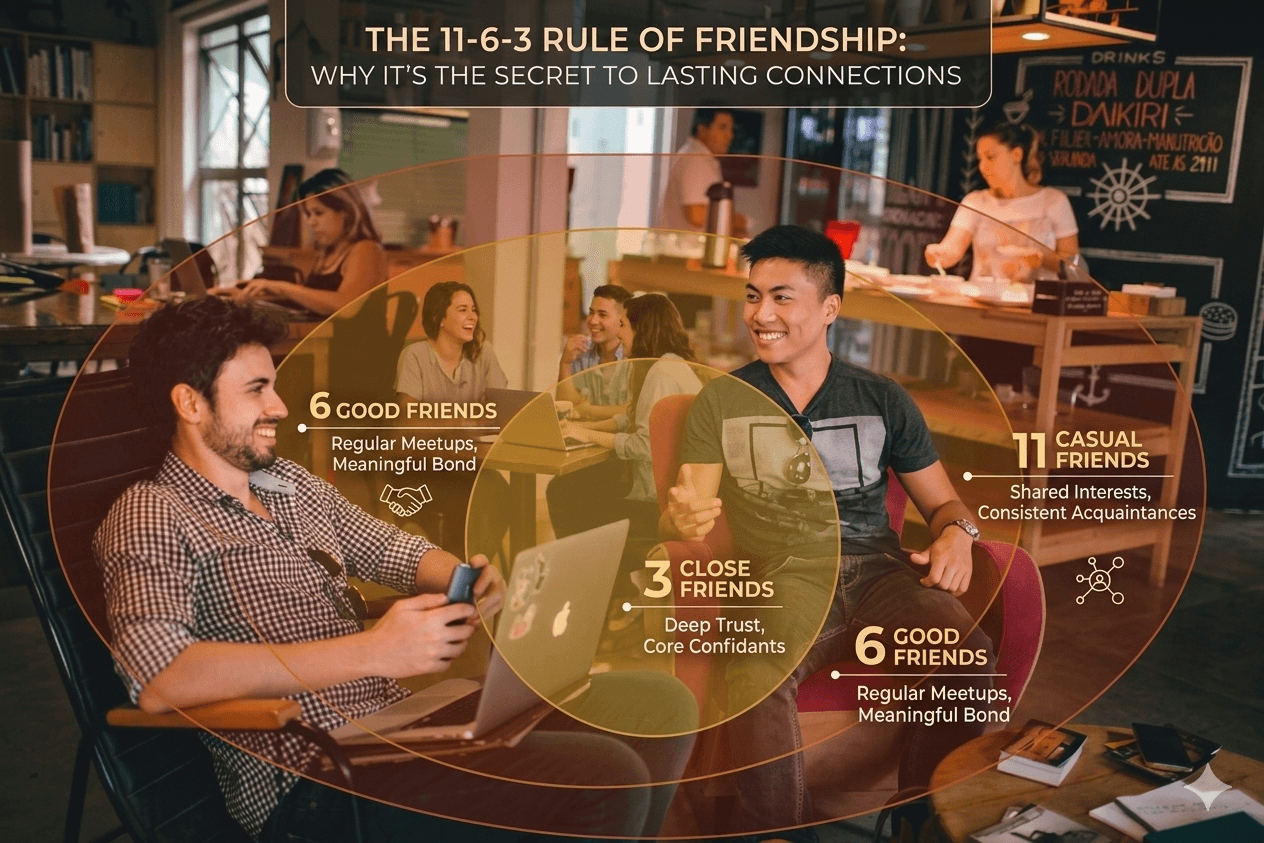
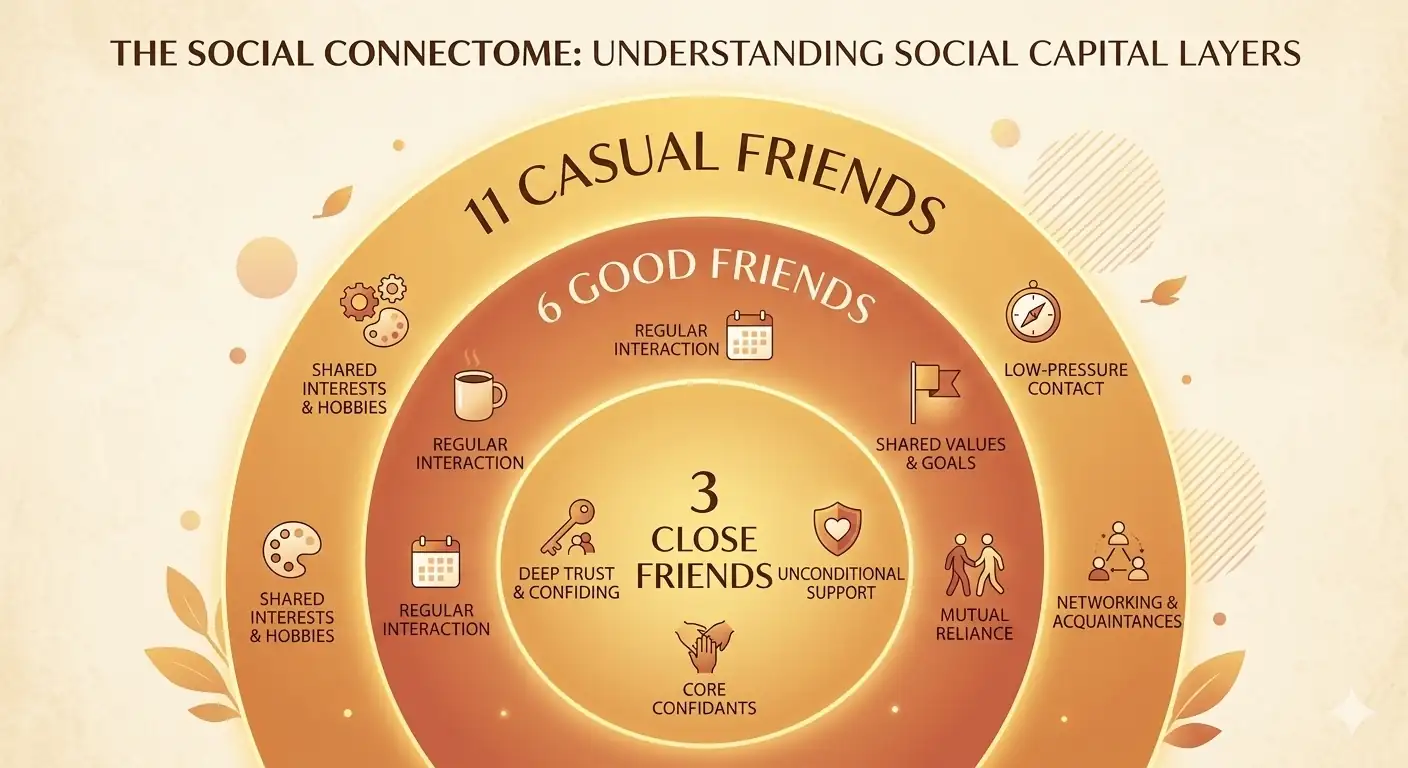
The 11-6-3 Rule of Friendship is a research-informed framework that describes the optimal structure of a healthy, balanced social circle. At its core, the rule suggests that a fulfilling social life is built in three concentric layers: 11 casual friends (people you enjoy spending time with occasionally), 6 good friends (people you turn to for support and shared experience), and 3 close friends (your inner circle, the people who truly know you).
It sounds deceptively simple. But the power of this framework lies in what it clarifies: that not all friendships are the same, that each layer serves a distinct psychological purpose, and that trying to turn everyone into a 'best friend', or spreading yourself too thin across dozens of shallow connections, leaves you socially and emotionally unfulfilled.
Where Does the 11-6-3 Rule Come From?
The 11-6-3 Rule didn't emerge from a single study, it's the synthesis of decades of research across evolutionary psychology, anthropology, and social neuroscience. The most foundational work underpinning it comes from British anthropologist and evolutionary psychologist Robin Dunbar, whose landmark research at Oxford University gave the world 'Dunbar's Number.'
Dunbar's research established that human beings can cognitively maintain a maximum of approximately 150 meaningful social relationships at any one time, a limit he tied directly to the size of the human neocortex. But within that 150, Dunbar identified a fractal-like layering: an innermost circle of roughly 5 (your support clique), expanding outward to 15 (sympathy group), 50 (social group), and 150 (the full tribe). The 11-6-3 Rule is a practical, everyday distillation of this inner layering, focused specifically on the friendships that meaningfully shape your emotional and psychological wellbeing.
Further support comes from research by Jeffrey Hall at the University of Kansas, which quantified the hours of shared time required to form friendships at different depths, work that maps almost precisely onto the three tiers of the 11-6-3 model.
Breaking Down the Three Layers
The 3: Your Inner Circle
Your three closest friends are your psychological bedrock. These are the people you call at 2am, the ones who've seen you fail and still show up, the ones with whom you can be completely unedited. Research consistently shows that having even one to three deeply trusting relationships is more predictive of life satisfaction, resilience, and even physical health than having a large but shallow social network.
A 2023 report by U.S. Surgeon General Dr. Vivek Murthy on the loneliness epidemic noted that the absence of even one close confidant is one of the strongest predictors of chronic loneliness, regardless of how many acquaintances a person has. Your inner circle doesn't need to be large. It needs to be real.
These friendships are built on mutual vulnerability, consistent history, and unconditional positive regard. They require the most investment, and return the most. Dunbar's research suggests we can realistically maintain only three to five relationships at this level of emotional intensity before cognitive and time resources are depleted.

The 6: Your Good Friends
Your six good friends form the middle layer, people you genuinely like and regularly spend time with, who provide a sense of belonging, shared identity, and emotional support, even if the relationship doesn't go to the absolute depths of your inner circle. Think: your work friend you have lunch with twice a week, your gym partner, the couple you and your partner go to dinner with regularly.
This layer is critically important for something psychologists call 'social buffering', the way that the presence of trusted others reduces cortisol (the stress hormone) in challenging situations. Research published in Psychoneuroendocrinology found that simply knowing supportive friends are available, even without direct contact, significantly reduces physiological stress responses. Your six good friends are your social buffer zone.
These relationships typically require around 100–150 hours of shared time to form and consistent effort to maintain. They're the people you'd invite to a birthday dinner, and who would genuinely want to come.
The 11: Your Casual Friends
Your eleven casual friends are the warm outer orbit of your social world. These are people you enjoy seeing at social events, have good conversations with, and feel genuinely positive about, but with whom you don't share deep personal history or regular one-on-one time. The neighbor whose company you enjoy at block parties. The person from your book club you always end up chatting with. The old colleague you grab coffee with twice a year.
Don't underestimate this layer. Sociologist Mark Granovetter's foundational research on the strength of weak ties demonstrated that our casual connections are often the most powerful bridges to new opportunities, perspectives, and, crucially, new deeper friendships. The casual layer is where your inner circle of tomorrow often begins today.
These relationships require relatively low maintenance but deliver disproportionately high returns in terms of social richness, exposure to diverse ideas, and a sense of being embedded in a community, all of which are independently linked to wellbeing and longevity.

Why This Structure Is Wired Into Human Biology
The 11-6-3 framework isn't just a productivity hack or a social media trend, it reflects something deeply embedded in human evolutionary history. For the vast majority of our existence as a species, humans lived in small, hierarchically structured social groups where survival literally depended on having the right people at the right level of closeness: a tight inner band for cooperation and emotional support, a wider band for collective security, and an outer band for trade and information exchange.
Robin Dunbar's research shows these grouping patterns appear consistently across hunter-gatherer societies, historical military units, and modern organizations, suggesting the layered social structure isn't cultural, it's cognitive. Our brains are literally built for this shape of social life. When we try to live outside it, either by having too few connections at any layer, or by collapsing the distinctions between layers, we experience social friction that manifests as loneliness, anxiety, or emotional exhaustion.
Signs Your 11-6-3 Structure Is Out of Balance
One of the most practical applications of this framework is as a diagnostic tool. Most people experiencing chronic loneliness or social dissatisfaction aren't failing at friendship broadly, they're failing at one specific layer. Here's what imbalance looks like at each level:
- Too few in your inner 3: You feel fundamentally unseen or unknown, even when socially busy. You have plenty of people to hang out with but no one you can truly confide in. This is the loneliness that coexists with a full social calendar, and it's the most painful kind.
- Too few in your middle 6: You feel socially adrift, you have one or two close people, but no broader sense of belonging or community. Life transitions (moving cities, divorce, changing jobs) often knock people out of this layer and leave them struggling to rebuild it.
- Too few in your outer 11: Life feels narrow and repetitive. You're missing the serendipity, diversity of perspective, and casual joy that a wider social orbit provides. You may be overly reliant on your inner circle for all forms of social nourishment, which can inadvertently strain those closest relationships.

How to Apply the 11-6-3 Rule in Your Own Life
Step 1: Map Your Current Social Circle
Take ten minutes and actually write it out. List the people currently in your life and assign each one a layer, inner 3, middle 6, or outer 11. Be honest. Some people we think of as close friends are really in the 'good friend' or even 'casual friend' category when we examine the actual depth and frequency of connection. This isn't a value judgment, it's a map. And maps are useful only when they're accurate.
Step 2: Identify Your Gaps
Which layer feels most underpopulated or fragile? For most adults, the inner 3 is most at risk, especially after major life changes like relocation, divorce, or losing a long-term friend group. For younger adults or recent graduates, it's often the middle 6 that's hardest to rebuild after leaving the built-in social structures of school. Once you identify your weakest layer, you can direct your energy precisely rather than scattershot.
Step 3: Invest Asymmetrically
Not all friendship investment is equal. Your inner three require deep, vulnerable, time-intensive engagement, meaningful one-on-one time, showing up during hard moments, and the kind of honest conversation that most people avoid. Your middle six need consistency, regular contact, shared activities, and follow-through on plans. Your outer eleven need warmth and low-friction access, the occasional message, showing up to community events, being someone who's genuinely glad to see people.
Trying to give everyone the same level of attention leads to burnout and surface-level connections everywhere. Investing asymmetrically, most deeply in your inner circle, and progressively lighter outward, is both sustainable and effective.
Step 4: Actively Move People Inward (and Allow Natural Outward Movement)
The 11-6-3 structure is not static. People move between layers over time, and that's healthy. The goal is to create conditions that allow meaningful people to move inward: deeper conversations, shared vulnerability, showing up during difficulty. It also means accepting, without guilt, that some people naturally drift to the outer layers or out of the circle entirely as life changes. This isn't failure, it's the natural ecology of a social life.
Practical tools for moving people inward include: scheduling regular one-on-one time (not just group hangouts), asking deeper questions, sharing something personal first to create a safe space for reciprocity, and creating shared rituals, recurring dinners, annual trips, consistent check-in calls, that build the shared history that close friendship runs on.

The 11-6-3 Rule and Digital Life
Social media has created an illusion of abundance, hundreds or thousands of 'friends' and 'followers', while leaving many people more isolated than ever. The 11-6-3 framework helps cut through this noise with a clarifying question: Which layer do these digital connections actually belong to?
Research from Dunbar's own 2016 study on Facebook friendships found that despite the average user having 150 Facebook friends, the number of people they could rely on in a crisis averaged just 4, closely mirroring the inner circle of the 11-6-3 model. Digital connection can absolutely support and supplement real friendship, but it rarely substitutes for the in-person time and shared experience that moves relationships inward through the layers.
Use platforms like Discord, WhatsApp group chats, or even Instagram close friends lists as maintenance tools for your existing layers, not as a replacement for building them.
Real-Life Scenarios: The 11-6-3 Rule in Action
After a big move: You arrive in a new city. Your inner three are back home. You have a handful of work colleagues (potential middle-six candidates) and a neighbor you've chatted with (outer eleven). Using the 11-6-3 framework, your immediate priority is clear: find recurring community activities to build your outer eleven, while deliberately deepening one or two work relationships toward your middle six. Don't rush your inner circle, that takes time and shared experience. Trust the process.
After a breakup or divorce: Many people discover that their ex-partner occupied multiple layers simultaneously, inner circle, middle-layer socializing, and daily casual connection all at once. The grief of this loss isn't just romantic, it's a structural collapse of your social architecture. The 11-6-3 framework helps you see this clearly and rebuild with intention rather than rushing into new relationships to fill every gap at once.
In your 40s and beyond: Life gets busier. Friendships demand more effort. The 11-6-3 model offers permission to let the outer layer thin slightly while protecting the inner layers fiercely. Quality over quantity becomes not just acceptable but strategically correct, and the research backs this up. Studies on friendship across the lifespan consistently show that older adults with a small number of high-quality friendships report greater wellbeing than younger adults with larger but shallower social networks.
FAQs: The 11-6-3 Rule of Friendship
- Is the 11-6-3 rule a strict requirement? No, it's a framework, not a prescription. Some people thrive with slightly fewer or more at each layer. The value is in the structure and awareness it creates, not the exact numbers.
- What if I don't have 3 close friends? You're in the majority. Research suggests that close, trusted friendships are the scarcest social resource in modern adult life. Start by deepening one relationship intentionally, one real close friend is infinitely more valuable than eleven superficial ones.
- Can romantic partners count in the inner 3? Yes, and for many people, a partner is naturally in the inner circle. Just be mindful not to let a partner be your only inner-circle relationship, as this creates unhealthy dependency and leaves you vulnerable if that relationship changes.
- How do I maintain all three layers without burning out? Asymmetric investment is the key (see above). Your outer eleven need very little, a warm message, a wave at a neighborhood event. Reserve your deepest energy for your inner three and let the outer layers be lighter, joyful, and low-pressure.
- Does quality really matter more than quantity? Definitively yes. A major meta-analysis in PLOS Medicine found that the quality of social relationships, not the number, is the strongest predictor of longevity and life satisfaction.
The Deeper Truth Behind the 11-6-3 Rule
What the 11-6-3 Rule ultimately reveals is that friendship is not a numbers game, it's an architecture game. The goal was never to collect as many friends as possible. It was to build a layered, living social structure that nourishes you at every level: the deep intimacy of your inner three, the belonging and buffering of your middle six, and the richness and serendipity of your outer eleven.
In a world that increasingly optimizes everything, productivity, fitness, finances, there's something quietly radical about applying that same intentionality to your social life. Not to engineer relationships, but to tend them. To show up. To invest where it matters most. And to understand, finally, that a life well-connected is not one with the most friends. It's one with the right friends, in the right layers, at the right depth.
That's not a limitation. That's a gift.